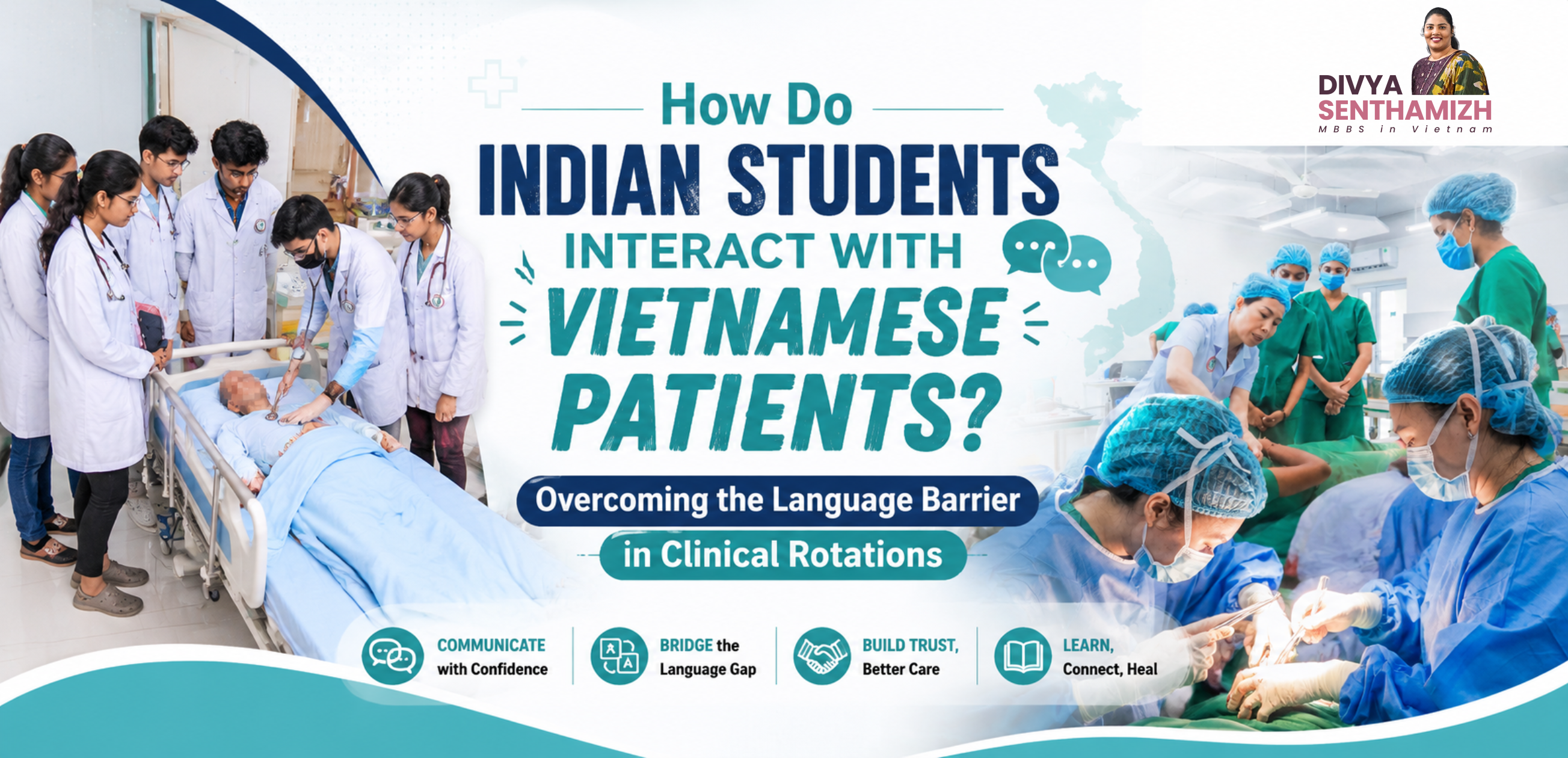
One of the first questions every parent and student asks before choosing to study MBBS in Vietnam is a practical one: if classes are taught in English, how do students actually communicate with Vietnamese-speaking patients during clinical rotations? It’s a fair concern — clinical training is the heart of medical education, and patient interaction is where theory becomes real skill. Here’s an honest look at how Indian students bridge this gap, and why it turns out to be far less of an obstacle than most people expect.
Why the Question Matters
MBBS in Vietnam for Indian students is taught almost entirely in English at the university level — lectures, textbooks, exams, and faculty instruction. But hospitals serving the local population naturally operate in Vietnamese. This creates a real gap during the clinical years, typically starting from year 3 or 4, when students move from classrooms into teaching hospitals and begin interacting directly with patients.
Unlike theoretical coursework, clinical rotations depend heavily on communication — taking a patient history, explaining a procedure, or simply putting someone at ease before an examination. So the language question isn’t a minor logistical detail; it directly shapes how well students learn.
How Universities Structure the Solution
Most universities offering MBBS in Vietnam have built systems specifically to handle this, rather than leaving students to figure it out on their own.
- Basic Vietnamese language modules Many programs introduce foundational Vietnamese language classes early in the curriculum, well before clinical rotations begin. These aren’t meant to create fluency, but to build enough vocabulary for common medical phrases — greetings, basic symptom questions, and instructions like “please breathe in” or “does this hurt?”
- Clinical interpreters and translator support During hospital postings, teaching hospitals typically assign interpreters or senior local students who assist with patient communication. This is standard practice across most international medical programs globally, not unique to Vietnam — even in countries like Germany or China, foreign students rely on similar interpreter support during early clinical years.
- Bilingual faculty and supervising doctors Clinical supervisors and attending physicians at partner teaching hospitals are frequently proficient in English, especially at university-affiliated hospitals that regularly host international students. They act as a bridge, explaining cases in English while managing the Vietnamese conversation with patients themselves.
- Peer learning with local students Vietnamese MBBS batches often study alongside international students in shared clinical groups. This peer relationship becomes one of the most effective — and organic — ways international students pick up practical language skills, as local classmates naturally translate and explain during ward rounds.
What Students Actually Experience on the Ground
Ask any senior studying MBBS in Vietnam, and a consistent pattern emerges. The first few clinical postings feel challenging, but comfort builds quickly, usually within a semester or two. Most describe picking up a working “medical Vietnamese” vocabulary — enough to conduct basic patient interviews independently — while still relying on interpreter support for complex case history-taking or sensitive conversations.
This mirrors what happens with international medical students everywhere. Communication skill in a foreign clinical setting is a gradual, cumulative process, not something anyone is expected to master immediately.
The Hidden Advantage: Building Cross-Cultural Communication Skills
Here’s something rarely discussed: navigating a language barrier during clinical training actually builds a skill set that pays off long after graduation. Doctors constantly work with patients who don’t share their first language — whether it’s a rural Indian patient speaking a regional dialect, or a diverse patient population in a hospital abroad. Students who study MBBS in Vietnam often graduate with stronger non-verbal communication skills, more patience during history-taking, and better instincts for reading a patient’s discomfort or confusion — skills that make them more adaptable doctors overall.
Compare this to a private Indian college graduate who trains exclusively with Hindi- or regional-language-speaking patients: they may never develop this particular skill until much later in their career, if at all.
Practical Tips for Incoming Students
If you’re planning to study MBBS in Vietnam and want to prepare ahead of clinical rotations, here’s what actually helps:
- Start basic Vietnamese early — even 20–30 common medical phrases learned in year one make a noticeable difference by year three
- Befriend local classmates — the fastest way to pick up conversational and clinical Vietnamese is through daily interaction, not textbooks
- Use translation apps as a backup, not a primary tool — apps help in a pinch, but real fluency comes from repeated practice
- Lean on hospital interpreter systems — they exist for a reason, and using them properly (rather than avoiding rotations) accelerates comfort over time
- Ask supervising doctors directly — most bilingual faculty are happy to translate a phrase or explain terminology when asked
Does This Affect Learning Quality?
This is the question that matters most to parents. The short answer: no, not meaningfully. Clinical competency is assessed on diagnostic reasoning, examination technique, and procedural skill — all of which are taught and evaluated in English by faculty. Patient communication in Vietnamese is a supplementary skill that develops alongside clinical training, supported by interpreters, rather than something students are left to manage alone from day one.
By the time students return to India for internship or prepare for the FMGE/NExT licensing exam, the language barrier experienced in Vietnam has typically become a genuine strength — evidence of adaptability that stands out in any medical career.
Final Thoughts
The language question is a legitimate one to raise before choosing to study MBBS in Vietnam, but it’s also one of the most over-worried-about aspects of the journey. Between structured language modules, interpreter support, bilingual faculty, and peer learning, Indian students consistently find their footing within their first few clinical postings. If anything, overcoming this early challenge becomes one of the more valuable, character-building parts of the entire MBBS in Vietnam experience — producing doctors who are more adaptable, patient, and prepared for the realities of practicing medicine anywhere in the world.